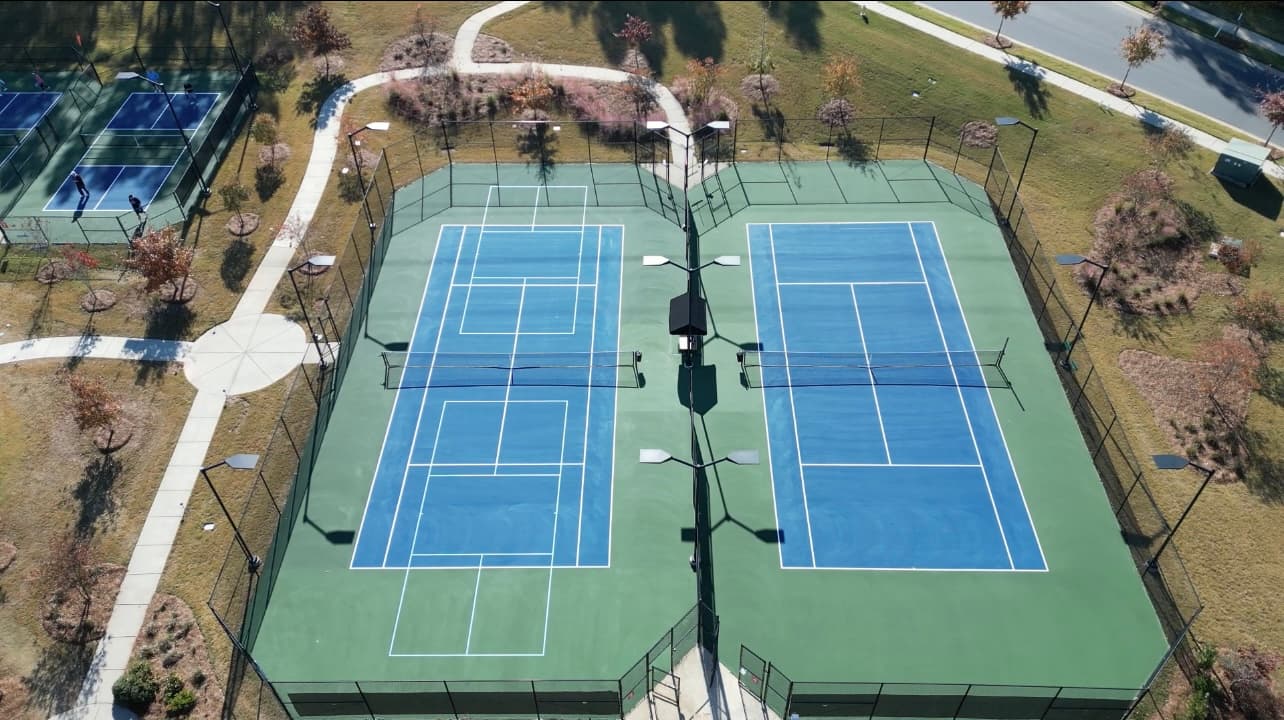
Professional surfacing for new and existing courts — designed for consistent ball response, dependable traction, and a finish that holds up to Charlotte sun.
Faded color, slick patches after rain, low spots that hold water, and uneven ball response — every tennis court tells you when it's due. The question is whether the right answer is a refresh, a full resurface, or addressing what's happening under the coats first.
Every recommendation starts with a site visit. We look at the base, the cracking pattern, the drainage, and the wear on the color coats — then build a plan around what your court actually needs.
New court surfacing & full systems
Resurfacing for worn or weathered courts
Crack repair coordinated with resurface
Custom color combinations & layouts
Pickleball striping on shared courts
Site-specific prep & application
Color & Layout
The Way Your Court Looks Is a Choice
From classic green-and-red to US Open blue or fully custom combinations — confirmed during the site visit before any product is ordered.
Color Option
Classic green & red
Color Option
US Open blue
Color Option
All-green
Color Option
Fresh line striping
Three Systems
Pick the System That Matches the Court
The right system depends on the condition of the existing surface and how the court will be used. Here's how the three most common options compare side by side.
Most Common
Standard Acrylic Resurfacing
Color coats applied directly over a prepared asphalt or concrete base. Durable, predictable, and the workhorse system for tennis courts in Charlotte.
100% acrylic color coats
Sand-blended for traction
True ball bounce and feel
UV-stable color retention
Best for
Existing courts with structurally sound bases.
Premium
Cushioned Acrylic System
A multi-layer build-up that adds a rubber-granule cushion beneath the color coats. Softer underfoot, easier on joints, no compromise on play.
Multi-layer cushion build-up
Reduced joint impact
Excellent traction and footing
Customizable cushion thickness
Best for
High-use courts and players who want a softer surface.
Lightest Touch
Color Coat Refresh
When the court is structurally fine but the color and traction have faded. Clean, patch minor blemishes, and recoat — without a full system rebuild.
Surface clean and prep
Minor patching as needed
Two-coat color application
Striping refresh included
Best for
Recently surfaced courts that just need a refresh.
Built for the Climate
Coatings That Don't Bake Off in Charlotte Summers
We apply professional-grade acrylic sport-surface systems — designed for athletic use, not general-purpose coatings repurposed for courts. The result is a finish that holds color and traction through Carolina heat, humidity, and UV exposure.
Cure window
50–90°F
Stable, dry, low-humidity application only.
Project time
4–7 days
Single-court resurface, weather permitting.
Resurface cycle
4–8 yrs
Depending on usage and sun exposure.
Coatings
UV-stable
Acrylic systems rated for Southern climates.
Tennis Court FAQs
Common Questions About Tennis Court Surfacing
A few of the questions we hear most often. If yours isn't covered here, get in touch and we'll walk you through it during a site visit.
How often should I resurface a tennis court?
Most outdoor tennis courts in the Charlotte area need resurfacing every 4 to 8 years, depending on usage, sun exposure, and how well the court has been maintained. Heavily used courts and those without windscreens or shade tend to land at the shorter end of that range. Watch for fading color, slick spots after rain, hairline cracks, and a chalky feel underfoot — those are usually the early signs that a recoat is due.
How long does tennis court resurfacing take?
A typical resurfacing job takes about 4 to 7 days from start to finish for a single court, weather permitting. New construction or full system applications run longer because each layer needs proper cure time. We schedule applications around forecasted dry weather so coatings cure properly and adhere to the surface as designed.
What time of year is best for tennis court surfacing in Charlotte?
Late spring through early fall is the sweet spot in the Charlotte area. Acrylic coatings cure best in stable temperatures roughly between 50°F and 90°F with low humidity and no rain in the immediate forecast. We avoid surfacing in cold snaps, during stretches of high humidity, or right before predicted rain — proper cure conditions are non-negotiable for a finish that holds up.
Can you change my court color?
Yes. Color is one of the most popular reasons our clients resurface. We can switch from traditional green-and-red to US Open blue-and-green, custom color combinations, or layouts that include accent colors for inside-the-lines play areas. We'll walk through color options during the site visit and confirm choices before any product is ordered.
Do you repair cracks before resurfacing?
Almost always — surface cracks should be addressed before any color coats go down. Coatings will not bridge an active crack, and skipping repair means the cracking will telegraph back through the new surface within a season or two. Depending on the type of cracking, we use flexible patching systems and acrylic crack-repair membranes designed to slow recurrence.
What's the difference between a hard court and a cushioned surface?
A standard hard court is acrylic color coats applied directly over an asphalt or concrete base — durable, low-maintenance, and consistent. A cushioned system adds a rubber-granule layer beneath the color coats that absorbs impact and reduces fatigue on knees and joints. Cushioned courts cost more up front but are noticeably easier on the body, especially for clubs, schools, and players who use the court often.
Karona Courts works with homeowners, communities, schools, and clubs throughout the greater Charlotte region. If you're nearby and don't see your town listed, reach out — we likely cover it.
Charlotte
Ballantyne
SouthPark
Huntersville
Cornelius
Davidson
Matthews
Mint Hill
Indian Trail
Waxhaw
Marvin
Concord
Lake Norman
Pineville
Fort Mill
Weddington
Ready to Resurface Your Tennis Court?
Schedule a site visit. We'll evaluate your court's current condition and walk you through the system, color, and timeline that fit your project.